 |
eFinancialPlanner
V1.0 (proof of concept)
Personal Financial Planning based on Maslowian Portfolio Theory
|
|
eFinancialPlanner
V1.0 (proof of concept)
Personal Financial Planning based on Maslowian Portfolio Theory
|
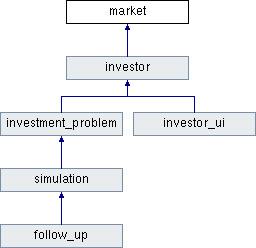
Public Member Functions | |
| market (int person=0) | |
| void | load_ER (int person=0, char person_type= 'i') |
| void | save_ER (int person=0, char person_type= 'i') |
| void | load_covar (int person, char person_type= 'i') |
| void | save_covar (int person, char person_type= 'i') |
Public Attributes | |
| float * | assetClass_covar = new float[(NBR_ASSET_CLASSES + 1) * (NBR_ASSET_CLASSES + 1)] |
| float | assetClass_mu [(NBR_ASSET_CLASSES+1)] |
| note: index 0 not used More... | |
| std::map< int, string > | assetClass_name |
| note: index 0 not used More... | |
| std::map< int, float > | ER |
| std::map< int, std::map< int, float > > | covar |
Protected Member Functions | |
| void | reload_ER (int person, char person_type= 'i') |
| TODO: the ER and assetClass_mu as well as the covar and assetClass_covar are redundant ==> eliminate the C-style assetClass_*. More... | |
| void | reload_covar (int person, char what2do, char person_type= 'i') |
market
this class provides all market information (expecter return, covariances)
(c) Philippe J.S. De Brouwer
last modification: 2015-02
Definition at line 11 of file market.class.cpp.
| market::market | ( | int | person = 0 | ) |
market CONSTRUCTOR
Definition at line 44 of file market.class.cpp.
| void market::load_covar | ( | int | person, |
| char | person_type = 'i' |
||
| ) |
load_covar
< note: person_type = 'i' for persons (later to provide for 'a' advisor, organization, etc.)
< TODO eliminate this
if we did not find a personalized expectation for each asset class, then we load the default values
< TODO eliminate this
Definition at line 135 of file market.class.cpp.
| void market::load_ER | ( | int | person = 0, |
| char | person_type = 'i' |
||
| ) |
load_ER
< note: person_type = 'i' for persons (later to provide for 'a' advisor, organization, etc.)
Definition at line 61 of file market.class.cpp.
|
protected |
reload_vol
the situation here is more complex as the user expect that only the volatilities will be reset to the default values and not the correlations ...
what2do = [v|c|b] as in [vol | corr | both]
< both
< volatilities
< correlations
Definition at line 281 of file market.class.cpp.
|
protected |
TODO: the ER and assetClass_mu as well as the covar and assetClass_covar are redundant ==> eliminate the C-style assetClass_*.
set_mu
the expect value for all asset classes set_covar
the expect value for all assets reload_ER
note: person_type = 'i' for persons (later to provide for 'a' advisor, organization, etc.)
this function simply deletes the personalized expected returns. This is sufficient because later we check if they exists and only then load them (see function load_ER().
Definition at line 247 of file market.class.cpp.
| void market::save_covar | ( | int | person, |
| char | person_type = 'i' |
||
| ) |
save_covar
Definition at line 172 of file market.class.cpp.
| void market::save_ER | ( | int | person = 0, |
| char | person_type = 'i' |
||
| ) |
save_ER
Definition at line 109 of file market.class.cpp.
| float* market::assetClass_covar = new float[(NBR_ASSET_CLASSES + 1) * (NBR_ASSET_CLASSES + 1)] |
Definition at line 16 of file market.class.cpp.
| float market::assetClass_mu[(NBR_ASSET_CLASSES+1)] |
note: index 0 not used
Definition at line 17 of file market.class.cpp.
| std::map<int, string> market::assetClass_name |
note: index 0 not used
Definition at line 18 of file market.class.cpp.
| std::map<int, std::map<int, float> > market::covar |
Definition at line 26 of file market.class.cpp.
| std::map<int, float> market::ER |
Definition at line 25 of file market.class.cpp.
 1.8.6
1.8.6 
